
I am postdoctoral fellow in policy in the School of Computer Science at Carnegie Mellon University, working at the intersection of technology, AI, and public policy. I recently earned my PhD in Societal Computing from CMU’s Software and Societal Systems Department, advised by Prof. Kathleen M. Carley.
My work bridges disciplines, and I use a variety of computational social science methods including social network analysis, survey analysis, and user studies.
Download my CV Download my Dissertation
About Me
My dissertation focused on developing effective and practical countermeasures to misinformation. While there has been substantial work on analyzing the effectiveness of various interventions, little work has been conducted on user acceptance — a critical component for implementation.
I studied interventions ranging from individual-level actions (e.g., reporting misinformation on social media) to platform or government-level policies. In the course of my work, I identified understudied strategies, evaluated user behavior and perceptions, and developed evaluation frameworks that consider both effectiveness and user acceptance. Some of my research has been highlighted in Psychology Today, a popular science magazine.
Before CMU, I earned a BS in Mathematics and an MS in Computational Operations Research at the College of William and Mary. My undergraduate thesis, “Nonlinear Models of Zooplankton Communities”, was completed with Prof. Sarah Day and Prof. Drew LaMar. For my Master’s capstone, I worked with Prof. Lawrence M. Leemis to develop a simulation that optimized resource allocation to lower voting times on Election Day. After my Master’s, I worked in industry (including as a Data Scientist at MITRE) before pursuing my PhD.
Featured Research
How Fairness, Effectiveness, and Intrusiveness Shape Public Support
Published:

When it comes to fighting misinformation on social media, public support is not guaranteed. New research from a survey of over 1,000 US social media users indicates that how fair an intervention feels matters more to Americans than whether they believe it will be effective.
What We Know and What We Don’t Know About Combatting Misinformation
Published:
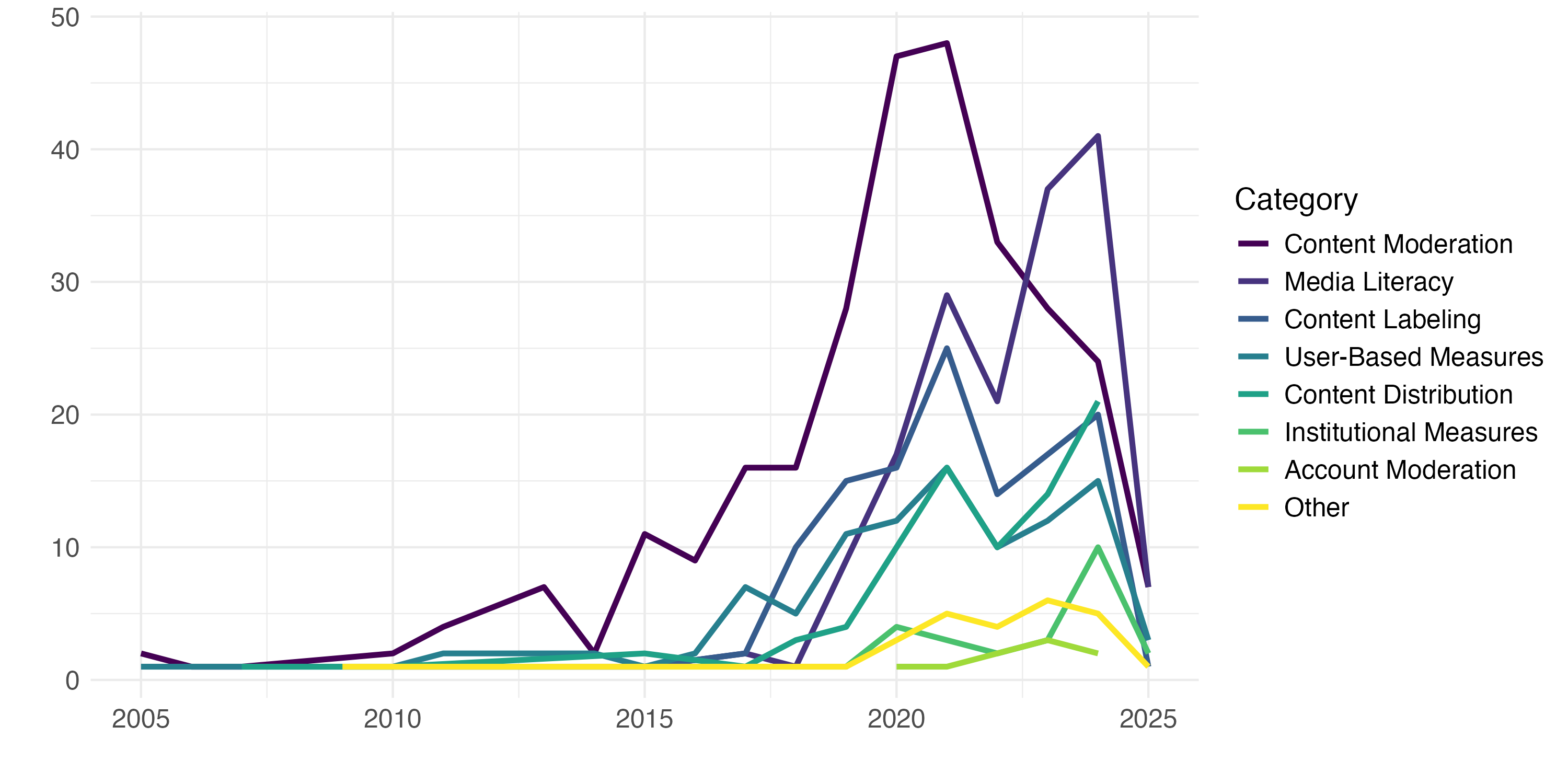
We reviewed over 450 academic papers on misinformation interventions across user, platform, and policy levels. Using bibliometric analysis, we discovered what’s been studied the most and the overlooked strategies that deserve more attention.
View all research blog posts →
Last Updated: August 7th, 2025